
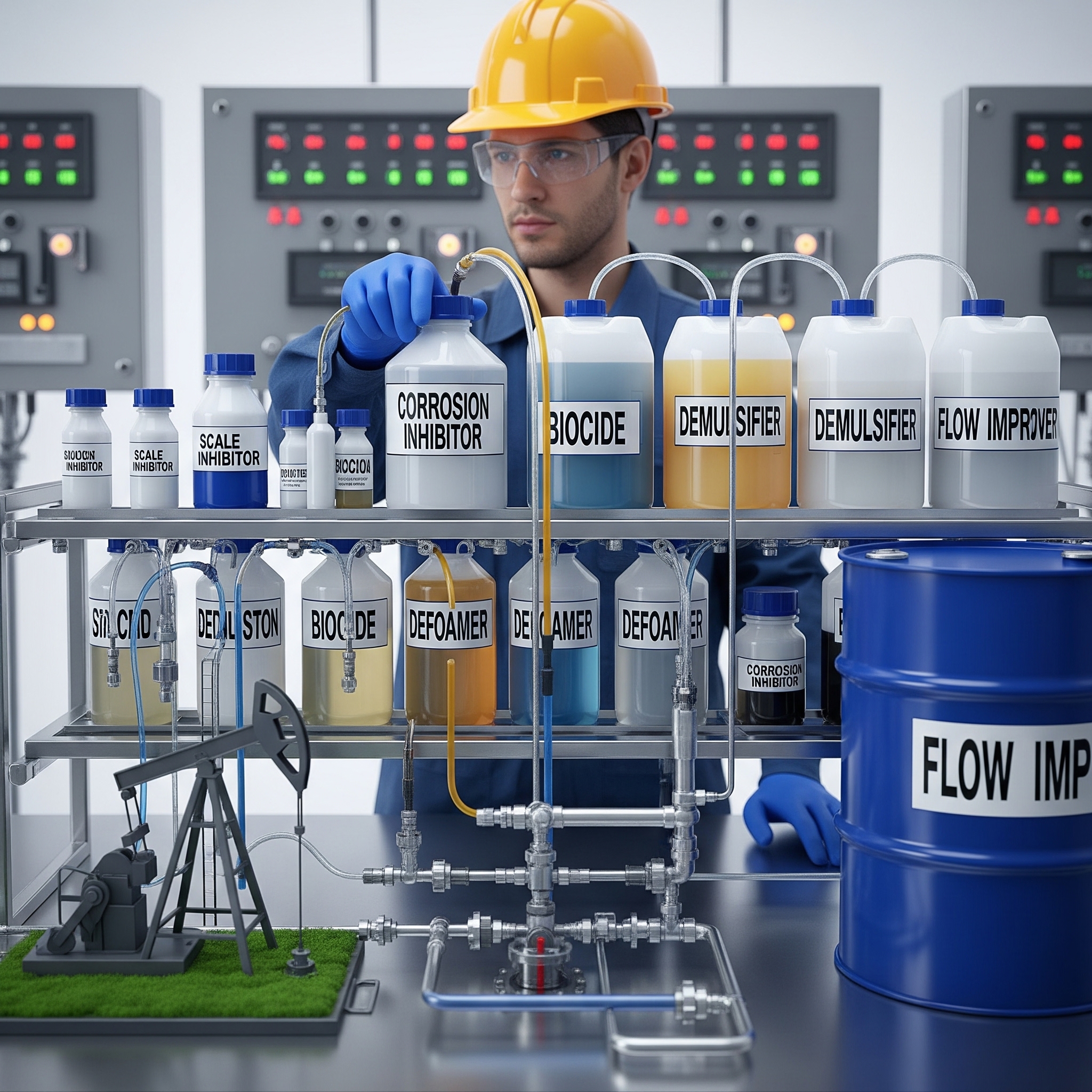
In upstream oil and gas operations, production chemicals are essential for maintaining flow assurance, protecting well integrity, and enhancing oil recovery. They address challenges such as deposition, corrosion, emulsions, and microbial activity that can negatively impact production efficiency. Key categories include:
Asphaltenes are heavy organic components in crude oil that can precipitate and deposit under changes in pressure, temperature, or composition. Asphaltene inhibitors and dispersants are applied to prevent blockages in wellbores, tubing, and surface facilities, ensuring smooth hydrocarbon flow.
Foam can form during production, separation, and processing of hydrocarbons, leading to reduced separator efficiency and potential carryover of liquids. Antifoaming agents (defoamers) are used to suppress foam, improving separation efficiency and protecting downstream equipment.
Paraffin waxes may precipitate and deposit in production tubing, flowlines, and surface equipment, restricting flow and reducing production efficiency. Paraffin inhibitors and dispersants are applied to prevent wax buildup and maintain flow assurance.
Scale inhibitors are used to control the deposition of inorganic mineral salts such as calcium carbonate, barium sulfate, and strontium sulfate. These deposits can block tubing and reduce reservoir permeability. Chemical inhibition helps maintain flow efficiency and minimizes costly remediation
Microorganisms such as sulfate-reducing bacteria (SRB) can cause reservoir souring (H₂S production) and microbiologically influenced corrosion (MIC). Biocides and microbial control programs are implemented to safeguard equipment and maintain safe operating conditions.
Produced water often contains dispersed oil, suspended solids, and other impurities that must be removed before disposal or reinjection. Water clarifiers (coagulants and flocculants) enhance oil-water separation, ensuring compliance with environmental standards and protecting water injection systems.
Corrosion in upstream facilities can result from exposure to CO₂, H₂S, oxygen, and saline water. Corrosion inhibitors are applied to protect pipelines, tubulars, and topside equipment, extending asset life and reducing operational risks.
Crude oil is often produced as a stable emulsion with water and solids. Demulsifiers break these emulsions, enabling efficient separation of oil, water, and solids in production facilities. This step is critical to meeting crude oil export specifications and ensuring effective downstream processing.
Petronova Oilfield Equipments & Spare Parts Trading LLC is a diversified oilfield supply and construction industry company, offering a complete range of engineering products and equipment to meet the needs of the energy sector.
